KSIF in Nairobi
A First International Signal
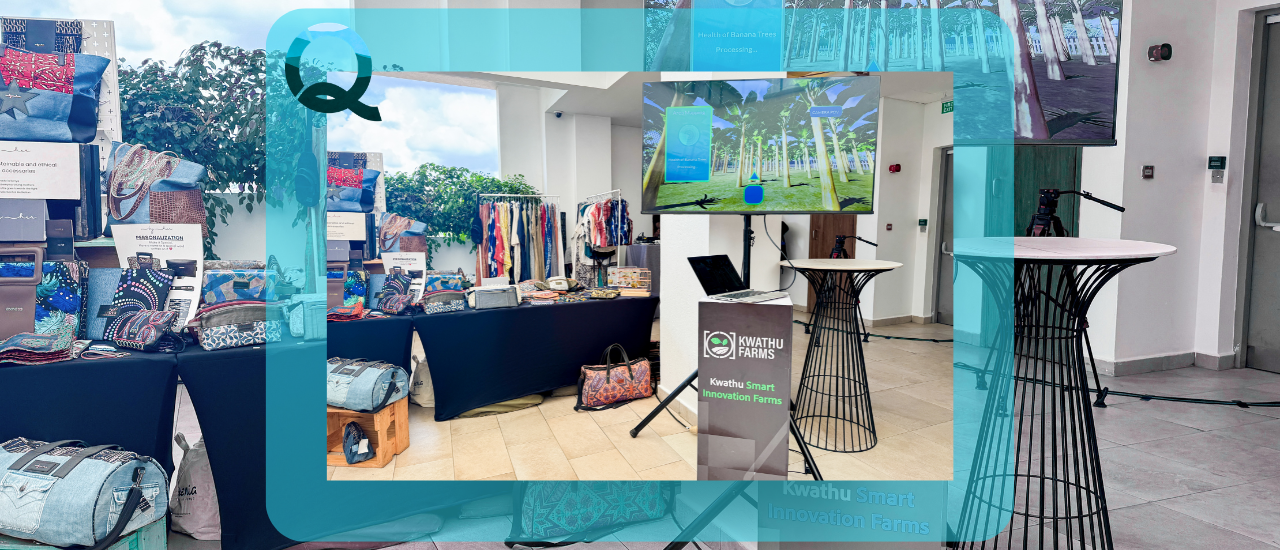
At AfricaXchange 2026 in Nairobi, Kwathu Smart Innovation Farms [KSIF] was presented for the first time on an international stage as part of the broader Q2 ecosystem. The showcase marked an important moment: not simply a demonstration of a concept, but the early articulation of an integrated system spanning simulation, autonomous infrastructure, and real-world deployment.
Positioned within a network of organizations working across food systems, energy, and community infrastructure, KSIF was introduced as an applied layer of a larger architecture. The objective was clear—to demonstrate how simulation-led environments can connect directly into physical systems through coordinated infrastructure.
What Was Demonstrated
The installation centered on a live simulation environment representing a digital farm system.
Users engaged with:
- terrain and environment mapping
- crop monitoring indicators
- interactive production scenarios
This simulation reflects a core component of Q2’s approach: the ability to model environments before physical deployment. The system is designed to allow decision-making to be tested, refined, and validated in a controlled digital environment.
Alongside this, the showcase introduced the early vision for autonomous systems within the same ecosystem. While not yet deployed at full scale, these systems represent the next layer—where sensing, movement, and data collection begin to operate within the physical environment.
The demonstration connected three elements:
- simulation (digital)
- environment (physical context)
- autonomy (future deployment layer)
KSIF Within the Q2 Ecosystem
Kwathu Smart Innovation Farms operates as an applied environment within the Q2 system.
Q2 is focused on building infrastructure that integrates:
- simulation
- coordination
- and physical deployment
Within this structure:
- KSIF provides the real-world environments where systems are tested and refined
- Q2 Simulation (Q2 Sim) provides the modeling layer
- QTrax enables tracking, monitoring, and coordination across systems
- Autonomous systems (QMicro, QP1, QH1) represent the operational layer for data capture and movement
This is not a collection of independent tools. It is a coordinated system designed to operate across environments.
Why Digital Twins Matter Now
The next phase of Q2’s work is centered on digital twins.
A digital twin is not simply a model. It is a continuously updated representation of a physical environment, informed by real-time data and capable of informing decisions.
In agriculture and infrastructure systems, this enables:
- environment-specific planning
- predictive modeling of outcomes
- real-time monitoring and adjustment
The KSIF simulation shown in Nairobi represents an early expression of this capability. The objective is to extend this into fully integrated digital twin systems that connect directly to physical operations.
From Demonstration to Deployment
AfricaXchange provided a platform to present the system.
The work now shifts toward deployment.
Key priorities include:
- advancing digital twin environments for agricultural systems
- integrating autonomous data collection into live environments
- expanding KSIF sites as applied infrastructure nodes
- strengthening coordination through QTrax
This phase focuses on moving from simulation as a demonstration to simulation as an operational layer.
Why This Matters for Investors and Partners
The convergence of:
- simulation technologies
- autonomous systems
- and infrastructure coordination
is creating a new category of systems.
Q2 is positioned at the intersection of:
- digital twins
- physical AI systems
- and applied environments in emerging markets
The ability to:
- model before deploying capital
- operate across distributed environments
- and integrate data into decision-making
creates a foundation for scalable infrastructure systems.
KSIF provides the applied context where these systems are grounded and validated.
Next Steps
Q2 is now engaging with partners and investors to:
- develop and deploy digital twin environments
- co-build autonomous system applications
- expand applied environments across agriculture and infrastructure
- integrate systems across multiple regions
Closing
AfricaXchange 2026 marked the first international showcase of KSIF within the Q2 ecosystem.
It demonstrated a system in its early stages—connecting simulation, environment, and autonomy.
The next phase is focused on building this into a fully operational infrastructure layer, where digital twins and physical systems operate in continuous coordination.
The direction is clear. The work now is execution.
Build the Future with Q2
Q2 Systems is building the next generation of cyber-physical infrastructure for emerging markets — integrating real-world systems, digital twins, and interactive simulations to generate the data, knowledge, and evidence needed to design smarter systems.
From agriculture and logistics to infrastructure planning and applied learning, Q2’s platforms help institutions test ideas, understand complex environments, and make better decisions before deploying resources in the physical world.
Investors & strategic partners
Collaborate with Q2 Systems as we expand pilots, simulation platforms, and infrastructure intelligence tools across emerging markets.
Contact: invest@q2corporation.com
Developers, engineers & creators
Work with Q2 Systems and Kwathu Kollective to build the next generation of simulation environments, applied learning systems, and cyber-physical tools. Visit q2corporation.com/careers
Public sector institutions & global development partners
Partner with Q2 Systems to deploy data-driven planning tools, digital twins, and simulation infrastructure that support smarter policy, infrastructure design, and last-mile innovation.
Contact: kollective@kwathu.org