Our Big Bets for the 25 Years Ahead
We are in 2026.
That places us firmly in the second quarter of the 21st century.
The first quarter of this century was defined by digitization: taking legacy processes, institutions, and behaviors and translating them into software. We built platforms, scaled connectivity, optimized speed, and automated execution. That work unlocked access, reduced friction, and connected billions.
But it also reached its limits.
What worked for the first 25 years of this century is structurally insufficient for the next 25. The world we now operate in has changed faster than the logic guiding its design.
The next quarter of the century demands a different foundation.
The Shift
The transition we are living through is often described as technological, but it is more accurately epistemic—a shift in how knowledge is produced, applied, and trusted.
We are no longer constrained by access to information. We are constrained by our ability to make sound decisions inside complex, dynamic systems. That distinction changes everything: how we learn, how we plan, how we build infrastructure, and how societies absorb risk.
This shift is already underway. Most institutions simply have not caught up to it yet.
Three Irreversible Conditions Shaping the Next Quarter-Century
1. Complexity Has Outpaced Intuition
Human intuition evolved for linear environments—clear causes, visible effects, short feedback loops. The systems we now operate inside are none of those things. They are nonlinear, interconnected, delayed, and feedback-driven. Small decisions compound. Large interventions backfire. Effects appear far from their causes and long after the moment of action.
- Human intuition evolved for linear systems
- Modern systems are nonlinear, delayed, feedback-driven
- Planning without simulation is now guesswork
- Failure modes are no longer obvious or immediate
The core challenge of the next 25 years is not speed. It is foresight.
2. AI Has Collapsed the Value of Knowing—and Raised the Value of Deciding
Artificial intelligence has fundamentally altered the economics of knowledge. Information is abundant. Content generation is cheap. Explanation is no longer scarce.
- Information is abundant and cheap
- Knowledge production has been destabilized
- Assessment, education, and training models built on recall are breaking
What is scarce now is judgment: the ability to decide under constraint, uncertainty, and competing objectives.
This has profound implications for education and workforce development. Systems built around memorization, static assessment, and content delivery are breaking—not because learners are weaker, but because the world no longer rewards recall. It rewards decision-making, adaptation, and systems awareness.
Learning must move from consuming information to navigating consequences.
3. The Global South Is Where These Systems Will Break—or Be Built Correctly
Emerging markets are often framed as “catching up.” In reality, they are where the future is being stress-tested first.
- Emerging markets are not “behind”; they are under stress first
- Climate volatility, infrastructure gaps, demographic pressure, informal economies, policy uncertainty
- These contexts expose system fragility earlier and more clearly
What works under imperfect conditions—unmapped terrain, capital scarcity, institutional ambiguity, human variability—is what scales globally. Systems that only function in ideal environments were never robust to begin with.
The next generation of infrastructure will be shaped where conditions are least forgiving.
This keeps the piece intellectual, not slide-like.
Energy as the Non-Negotiable Foundation
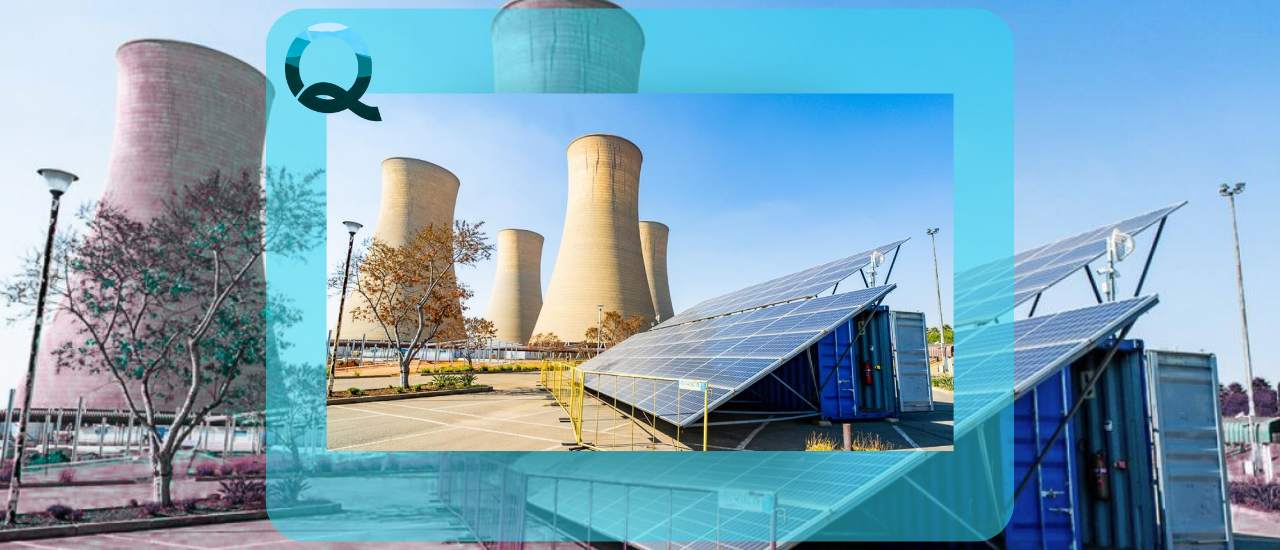
There is a quieter constraint running beneath every transformation described above: energy.
The next quarter of the century will not be limited by a lack of intelligence. It will be limited by the systems that power intelligence at scale. Artificial intelligence, simulation environments, autonomous systems, and real-time digital infrastructure all depend on reliable, affordable, and adaptive energy. Without it, intelligence remains theoretical.
This creates a tension that many current narratives avoid.
- Intelligence-native systems increase energy demand, not reduce it.
- Simulation, AI, autonomy, and continuous learning are computationally and energetically intensive.
- Infrastructure designed without energy resilience becomes brittle as intelligence scales.
In emerging markets especially, energy is not an abstract concern. It determines whether systems can operate at all.
- Fragile or centralized grids limit what can be deployed.
- Assumptions of uninterrupted power collapse under real conditions.
- Variability is the norm, not the exception.
As intelligence becomes embedded into education, production, mobility, and governance, energy becomes the rate-limiting factor of progress.
The Core Bet of the Next Quarter: Intelligence-Native Infrastructure
The next 25 years will not be defined by smarter tools layered onto old logic. They will be defined by intelligence-native systems: infrastructure designed from the outset to learn, adapt, and reason over time.
Intelligence-native infrastructure rests on a few foundational assumptions.
- AI exists. Systems can no longer be designed as if humans are the sole cognitive agents. The challenge is not whether machines think, but how human judgment and machine intelligence interact responsibly within real-world constraints.
- Learning must be embedded in action. Education cannot remain siloed from decision-making. The environments where people play, experiment, fail, and iterate are where real understanding forms. This is where the Play · Learn · Earn · Build (PLEB) loop becomes essential—not as a slogan, but as a structural model. Play lowers the cost of failure. Learning emerges through feedback. Earning rewards applied competence. Building feeds insight back into real systems.
- Simulation must precede deployment. Digital twins alone allow observation. Games alone allow abstraction. What is required now are environments where futures can be explored safely—where decisions are tested before their costs are paid in reality. Simulation becomes a prerequisite for scale.
- Systems must function under imperfect conditions. The next quarter will not be defined by clean data, stable policy, or uniform capacity. Infrastructure must assume variance, ambiguity, and constraint—and still adapt.
The systems that endure will not simply execute instructions. They will learn from interaction.